How Linux entered my life
I got my first computer when I was a young teenager. If my memory is right, it had an AMD K5 running at 133 MHz, 16 MB of RAM, and Windows 95. Today those numbers look like a typo. At the time, they described the most interesting object in the world.
My cousin assembled it for us. He was the family’s technology expert, the person who understood what all the parts did and could make them work together. He was also one of the first people I knew who owned a CD writer, which in those days felt less like having a peripheral and more like owning industrial equipment.
The night before the computer arrived, I could not sleep. I eventually gave up trying and walked around the neighborhood until dawn, waiting for the hours to pass. I don’t think I have ever anticipated the delivery of another machine with quite that intensity.
Once it was on my desk, I wanted to know everything it could do. I played games, of course, but I also started learning BASIC. Some of my earliest programs were primitive question-and-answer scripts. They asked how I was feeling, accepted a few possible answers, and printed something reassuring in response. They were not intelligent by any definition, but I liked the idea that a computer could respond to a person and perhaps make them feel a little better.
I also learned how to repair the machine, partly because computers needed a fair amount of repairing then and partly because I could not leave it alone. Windows 95 installations were temporary arrangements. Sooner or later something would break, and reinstalling the operating system was simply another computer skill to learn.
Then, during a summer trip with my mother, I had mixed feelings. I liked going to the seaside, but it also meant being away from the computer. While we were out, I bought a copy of the Croatian computer magazine VIDI at a newsstand. It was the July/August 1998 double issue, number 29-30.
That issue introduced me to Linux.
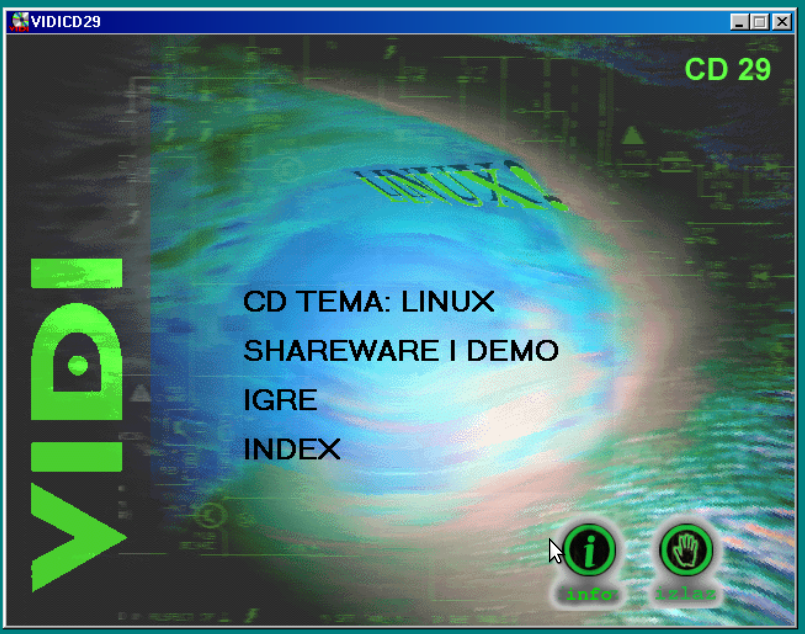
The CD launcher put “CD TEMA: LINUX” first. Source: VIDI CD-ROM #29-30 at the Internet Archive (original PNG).

Until then, my idea of a computer operating system was DOS or Windows. The magazine described something else entirely: an operating system that was free, had a command line, and also had a graphical interface. The combination amazed me. I read that section repeatedly. Since I had no computer with me, I memorized commands and tried to build a picture in my head of how it all worked.
The magazine came with a CD. As soon as we returned home, I put it into my computer and started the installation.
The distribution on that disc was Debian GNU/Linux 1.3.1 r6, better known as Bo. The VIDI 29-30 CD has since been archived, so the exact contents no longer have to depend on my memory. The disc did include X11 packages, but Debian’s base installation did not install and configure a graphical desktop automatically. That was a separate job.
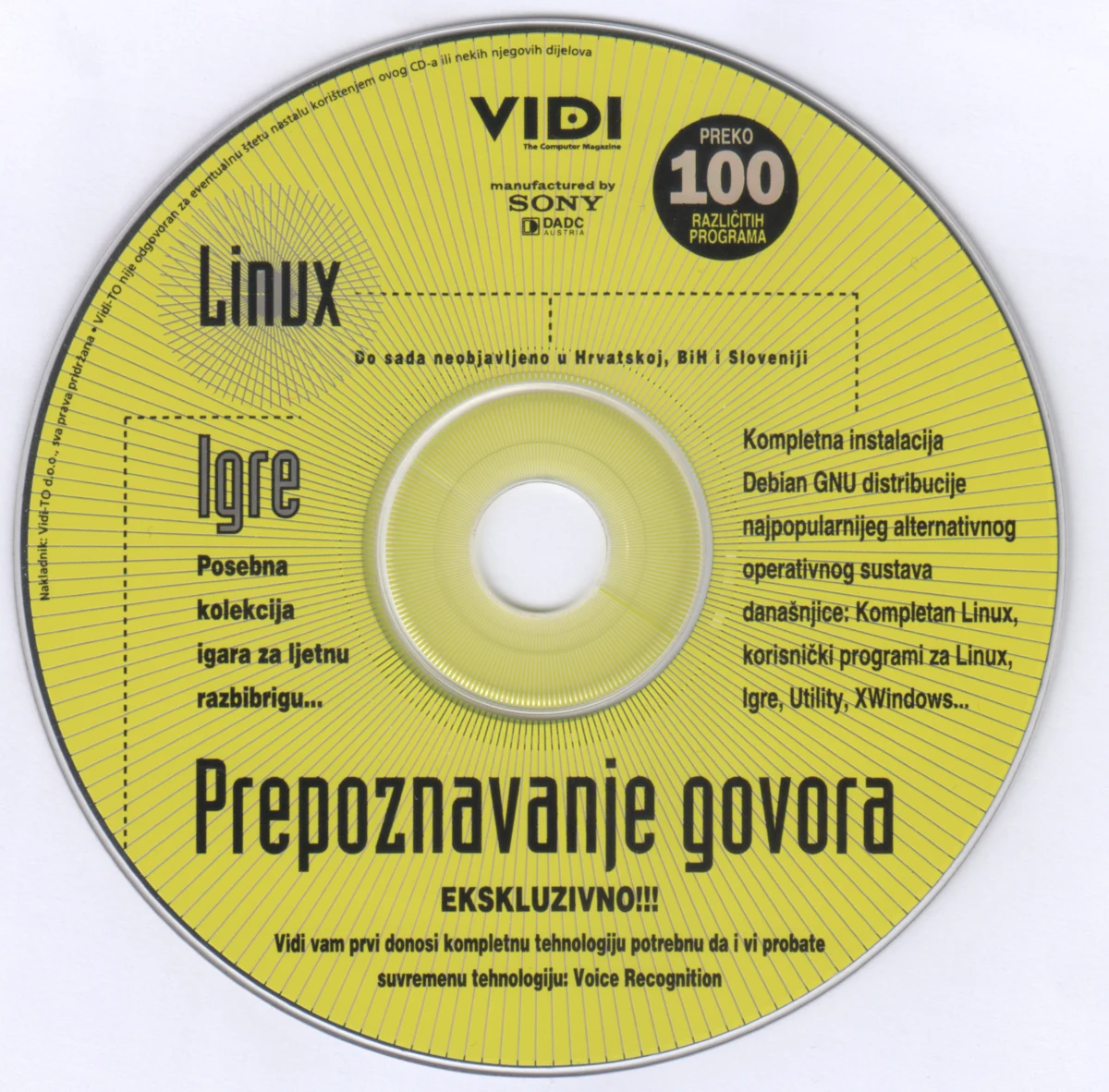
The VIDI 29-30 CD. Source: VIDI CD-ROM #29-30 at the Internet Archive (original scan).

Before reaching that disappointment, I had already made a more immediate discovery about bootloaders and the master boot record.
The article had not prepared me for that part. I proceeded with the installation believing that I would be able to choose between Linux and Windows afterward. Instead, when I restarted the computer, Windows had disappeared from the startup options.
Oddly enough, this did not frighten me very much. Windows 95 had been reinstalled often enough that losing it felt inconvenient rather than catastrophic. I could always put it back. The important thing was that I finally had Linux.
Except that the Linux I had was a command prompt.
I had expected the graphical interface from the magazine. What I got was text, a blinking cursor, and very little idea of what to do next. All those commands I had memorized were suddenly less impressive when they were the only way to communicate with a machine that had looked perfectly healthy a few hours earlier.
I remember the next problem having something to do with the graphics card, an S3 Trio. XFree86 used different servers for different video chipsets, and getting the right one selected and configured was not a friendly process for a beginner. The required X software was already on the VIDI CD, but at the time I became convinced that I needed another package or driver from the Internet.
Over dial-up, that meant starting the download in the evening and leaving the computer connected through the night, hoping the telephone line would behave. It did not. The connection reset, the download failed, and in the morning I was still looking at the same command line.
My Linux bubble burst quickly. I had started with the idea of a free and almost magical alternative operating system. I ended with a computer that, from my teenage point of view, had become brain-dead. It could boot, display text, and wait for me to know things I did not yet know.
That first Linux installation was not a success in any useful sense. I lost my familiar startup path, failed to configure the GUI I expected, and spent a night downloading something I probably did not need. Still, the failure taught me something that the smooth Windows desktop could not. A computer was not one fixed thing. Its operating system could be replaced, broken, examined, and rebuilt. There were other ways for a machine to work, even if my first attempt left it apparently unable to do much at all.
That summer magazine had promised me a new world. On the first try, I mostly got a blinking cursor. It was enough to make me curious, and curiosity proved much harder to remove than Windows 95 from a boot menu.
📄 View source (.md)